
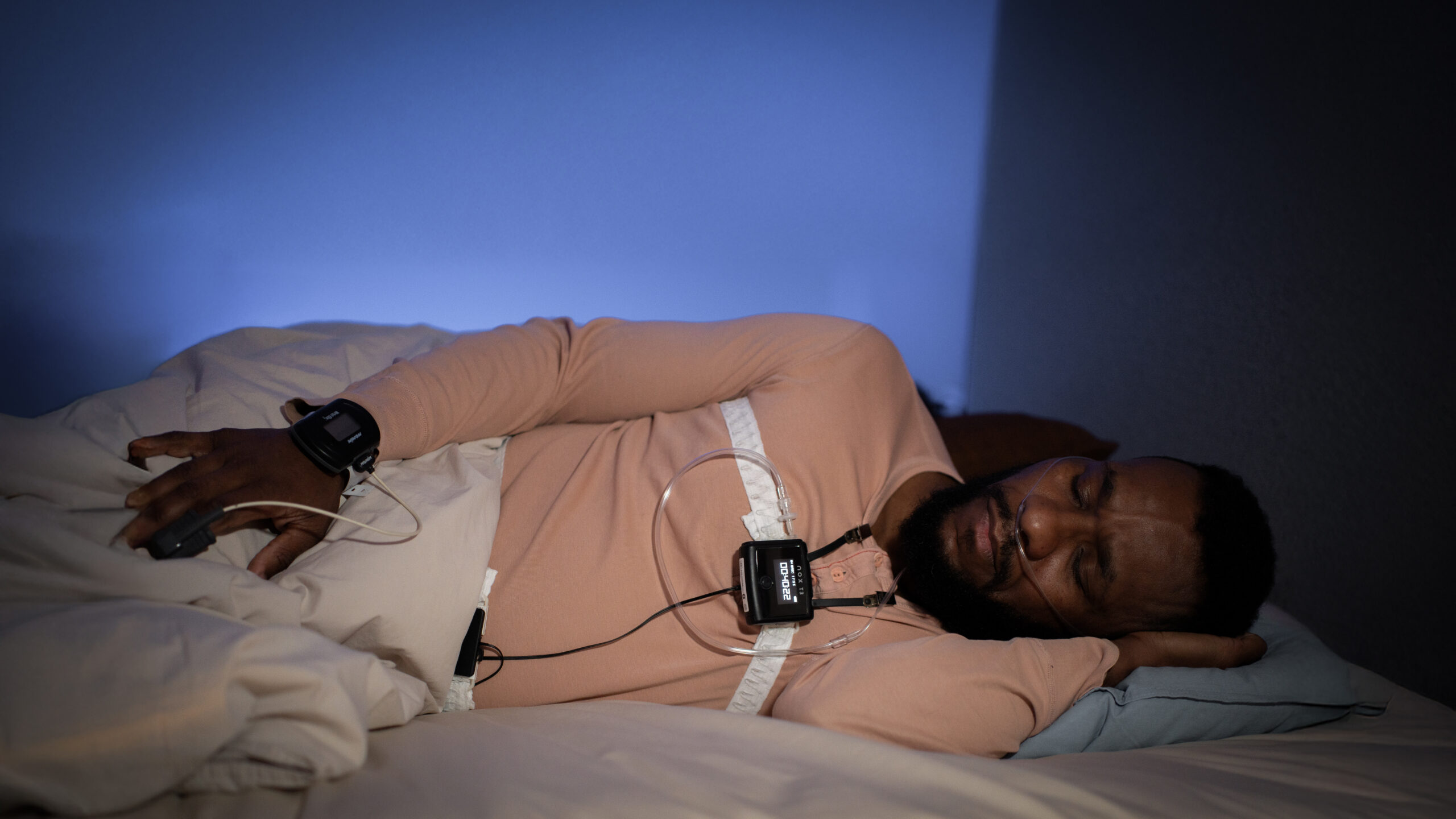
A home sleep apnea test captures what happens during sleep. But when obstructive sleep apnea (OSA) changes from night to night, one night may not always tell the whole story. How can multi-night testing change the picture?
Research has shown substantial night-to-night variability in OSA severity. In a study of more than 10,000 adults undergoing three consecutive nights of home sleep testing, approximately one in five people classified as having mild or moderate OSA were misclassified when assessment was based on a single night.1 A much larger longitudinal study similarly found that single-night assessment can misclassify OSA severity, particularly around clinically important thresholds.2
Practically, however, how do you make multi-night clinical home sleep testing scalable?
More nights only help if the data remain meaningful
Simply recording more nights does not automatically create better clinical information.
A scalable multi-night approach requires respiratory signals that remain reliable across repeated recordings, a testing experience patients can reasonably repeat, and workflows capable of managing and interpreting the additional data.
Measuring airflow is central to that equation.
OSA is characterized by repeated reductions or interruptions in breathing during sleep. Airflow is therefore one of the fundamental physiological signals used to recognize respiratory events and understand how breathing changes across the night.
When testing extends across several nights, maintaining reliable information about breathing becomes even more important. More recording time has limited value if the respiratory signal is inconsistent or missing during portions of the study.
Airflow beyond the nasal cannula
Nasal pressure is commonly used to derive airflow during sleep testing, but the signal can be affected by factors including oral breathing or displacement of the cannula during sleep.
Nox approaches airflow differently through volumetric respiratory inductance plethysmography (RIP).
Dual Nox RIP belts measure changes in the cross-sectional area of the thorax and abdomen as the patient breathes. Through continuous calibration and signal processing, these measurements are combined to estimate changes in respiratory volume, from which airflow can be derived. Unlike RIP systems that primarily track breathing movement, volumetric RIP provides a physiologically grounded measure of both respiration effort and ventilation.7
Research comparing RIP-derived ventilation with pneumotachography has demonstrated close agreement in the measurement of changes in ventilation and respiratory event depth.3 The design of the RIP belts themselves also matters: research has shown that belt design influences the reliability and quality of respiratory signals.4
This creates an important distinction for multi-night testing. Instead of treating RIP signals as secondary, volumetric RIP can provide physiologically grounded information about airflow throughout the recording.
What makes multi-night testing scalable?
The clinical rationale for multi-night testing is only part of the challenge. The operational model also has to work. If every additional night requires a new device setup, new logistics, and a proportional increase in manual scoring, multi-night testing can quickly become difficult to scale.
The Nox T3s can support multiple-night studies, meaning that additional nights can be collected using the same home sleep testing platform rather than introducing a separate diagnostic workflow.
As the number of nights increases, automated analysis can help manage the additional volume of physiological data.
Where AI-assisted analysis fits
Nox DeepResp™ is FDA-cleared, CE-marked software that analyzes respiratory signals to automatically score sleep states, arousals, and respiratory events from home sleep recordings. Medical professionals retain oversight of the final scoring and interpretation.
This matters for scalable testing because the amount of data grows with every additional night.
Research has shown that sleep and arousal information can be derived from respiratory inductance plethysmography using deep learning.5 DeepResp builds on this approach to add sleep and arousal information to Type III home sleep testing and generate an AHI comparable to that from PSG-based assessment in its clinical validation.6
Automated analysis can support multi-night sleep studies, thereby providing clinicians with detailed physiological information across multiple nights without increasing the need for manual analysis.
From a single snapshot to a longitudinal view
Multi-night testing should not be understood as simply “more testing.” Its potential value lies in seeing respiratory physiology across time.
One night may capture a representative picture for many patients. For others, night-to-night variability means that another night may show something different.
Reliable respiratory signals, patient-friendly home acquisition, volumetric airflow measurement, and AI-assisted analysis all contribute to capture that variability.
When OSA does not look exactly the same every night, scalable multi-night testing could help clinicians see more of the story.
LBL-0724 REV 01
References
- Punjabi, N. M., Patil, S., Crainiceanu, C., & Aurora, R. N. (2020). Variability and misclassification of sleep apnea severity based on multi-night testing. Chest, 158(1), 365–373. https://doi.org/10.1016/j.chest.2020.01.039
- Lechat, B., Naik, G., Reynolds, A., Aishah, A., Scott, H., Loffler, K. A., Vakulin, A., Escourrou, P., McEvoy, R. D., Adams, R. J., Catcheside, P. G., & Eckert, D. J. (2022). Multinight prevalence, variability, and diagnostic misclassification of obstructive sleep apnea. American Journal of Respiratory and Critical Care Medicine, 205(5), 563–569. https://doi.org/10.1164/rccm.202107-1761OC
- Finnsson, E., Arnardottir, E., Montazeri, K., Keenan, B. T., Schwab, R. J., Gislason, T., Pack, A. I., Wellman, A., Islind, A. S., Ágústsson, J. S., & Sands, S. A. (2026). Respiratory inductance plethysmography to quantify changes in ventilation in obstructive sleep apnea. IEEE Transactions on Biomedical Engineering, 73(5), 1943–1952. https://doi.org/10.1109/TBME.2025.3618403
- Montazeri, K., Agustsson, J. S., Serwatko, M., Gislason, T., Jonsson, S., & Arnardottir, E. S. (2021). The design of RIP belts impacts the reliability and quality of the measured respiratory signals. Sleep and Breathing, 25, 1607–1616. https://doi.org/10.1007/s11325-020-02258-7
- Finnsson, E., Erlingsson, E., Hlynsson, H. D., Valsdóttir, V., Sigmarsdottir, T. B., Arnardóttir, E., Sands, S. A., Jónsson, S. Æ., Islind, A. S., & Ágústsson, J. S. (2025). Detecting arousals and sleep from respiratory inductance plethysmography. Sleep and Breathing, 29, Article 155. https://doi.org/10.1007/s11325-025-03325-z
- U.S. Food and Drug Administration. (2025). 510(k) summary: DeepRESP v2.0 (K252330). U.S. Department of Health and Human Services.
- Bjarkason, S., Finnsson, E., Sigþórsson, S., Sigmarsdóttir, Þ., Hugosdóttir, R., Höskuldsson, S., & Ágústsson, J. S. (2026). Toward physiology-based sleep assessment: The emerging clinical role of advanced RIP technology. Current Pulmonology Reports, 15, Article 10. https://doi.org/10.1007/s13665-026-00410-w
Topic: Research & Publications


