
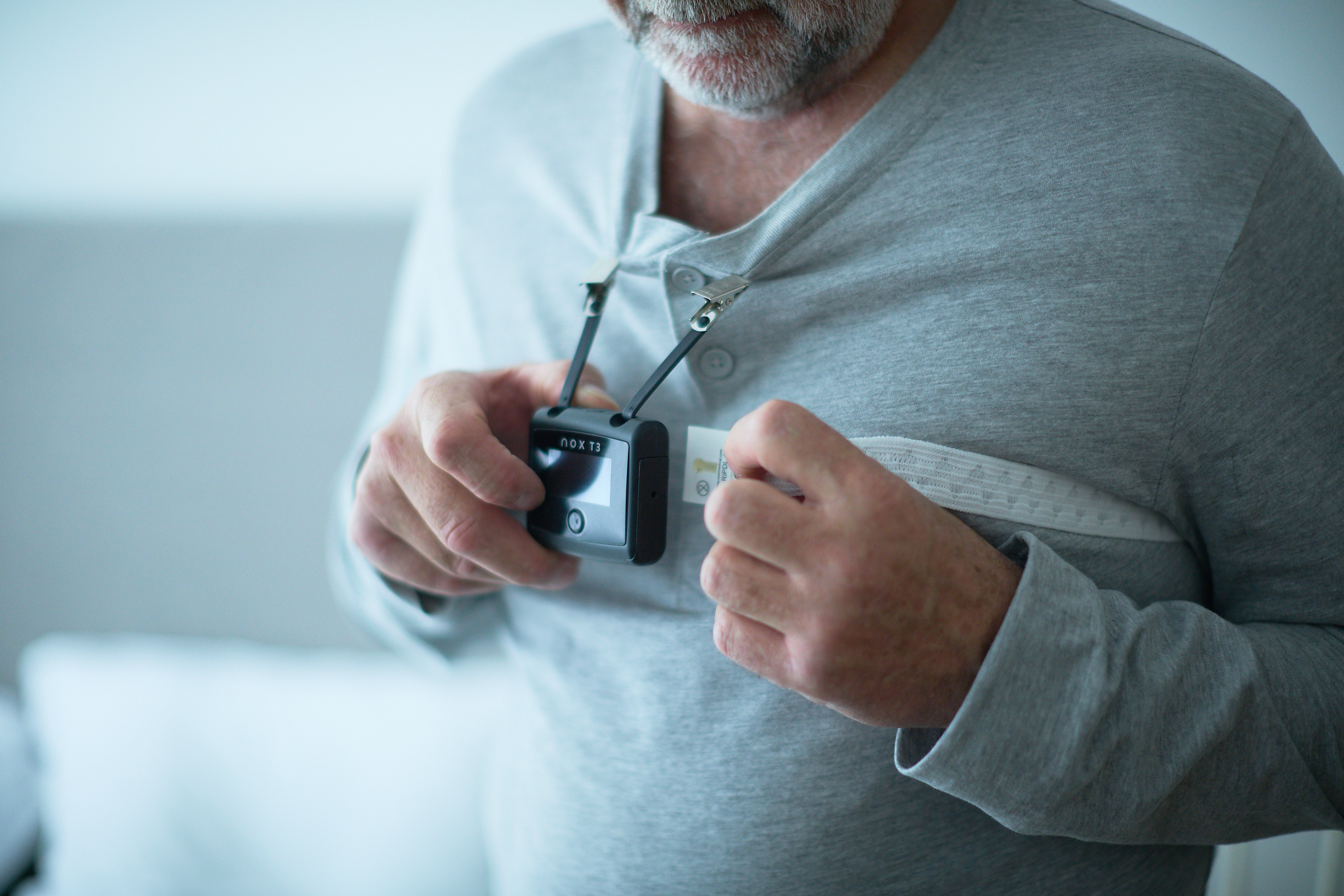
At SLEEP 2026 in Baltimore, attendees will have the opportunity to explore new research from Nox addressing some of the most pressing questions in sleep medicine today: How can home sleep apnea testing become more conclusive? How can AI support clinicians without adding complexity? How can care models better serve patients with overlapping sleep disorders? And how can digital treatment options contribute to meaningful, lasting outcomes?
Seven Nox-related abstracts accepted for presentation at SLEEP 2026 offer insights across these questions. Together, they highlight practical evidence for clinicians, researchers, payers, employers, and healthcare leaders who are focused on improving the way sleep disorders are identified, treated, and managed in real-world settings.
Rather than focusing only on new technology, these presentations examine problems that affect everyday sleep care: inconclusive tests, repeat testing, delayed diagnosis, under-recognition of sleep apnea in women, central sleep apnea scoring, comorbid insomnia and sleep apnea, and the long-term relationship between insomnia treatment and mental health.
For attendees, these sessions offer a chance to learn how emerging tools and integrated care models may help make sleep care more accurate, accessible, efficient, and patient-centered.
Learning How AI May Help Make Home Sleep Testing More Conclusive
When a home sleep apnea test does not produce a clear answer, patients may need repeat testing, treatment may be delayed, and care teams must spend additional time resolving uncertainty.
One abstract, “Making Type III HSAT Recordings Conclusive: Large-Scale Validation of an FDA-Cleared AI AHI Classifier from HSAT Signals,” addresses this challenge and explores how AI-derived AHI from home sleep apnea testing compares with conventional AHI from attended polysomnography.
Attendees interested in diagnostic quality and operational efficiency may find this work especially relevant. The research suggests that AI-supported HSAT can closely align with attended polysomnography while reducing the likelihood of retesting and helping patients move more quickly from testing to treatment.
The abstract also examines performance across demographic subgroups, including age, sex, BMI, and race or ethnicity. That makes the findings relevant not only to questions of accuracy, but also to questions of consistency and equity. For clinicians and healthcare leaders evaluating AI tools, understanding whether performance holds across diverse populations is essential.
Learning Whether RIP-Only HSAT Could Reduce Testing Friction
Another practical challenge in home sleep testing is signal reliability. Nasal cannulas are commonly used in Type III HSAT, but they can become displaced, uncomfortable, or difficult to use correctly. Poor signal quality can contribute to inconclusive studies and repeat testing.
The abstract “Conclusive AHI from RIP-Only Type III HSAT: Comparison of RIP-Based and Cannula-Based AI Analyses in a Large Multicenter Cohort” addresses whether RIP-only HSAT analyzed by AI can perform comparably to traditional nasal-cannula-based HSAT for determining sleep apnea severity.
For attendees, this research raises an important question: can home sleep testing be simplified without sacrificing clinical confidence?
If RIP-only testing supported by AI can produce comparable severity classification, it may point toward a more patient-friendly and operationally efficient testing experience. That could matter for programs seeking to reduce failed studies, improve completion rates, and lessen the burden on patients and care teams.
Learning How Automation May Support Central Sleep Apnea Evaluation
Central sleep apnea evaluation can add complexity to diagnostic workflows, particularly when care teams need to distinguish central from obstructive events.
The abstract “Fully automated central apnea scoring in home sleep apnea testing using dual volumetric RIP and AI analysis” examines the use of HSAT plus AI for fully automated central apnea scoring.
For attendees, the learning opportunity is centered on workflow simplification and clinical decision support. The research found high agreement with expert scoring and high specificity for central events, without requiring central-apnea-specific rescoring beyond standard clinical review.
This may be especially useful for clinicians and program leaders interested in how automation can support, but not replace, expert oversight. By reducing manual burden and helping identify central events more efficiently, AI-assisted scoring could help care teams evaluate patients more consistently and guide appropriate treatment decisions.
Learning How AI-Derived AHI May Change the Interpretation of Inconclusive or Negative HSATs
One of the most important questions in sleep medicine is not only whether a test works, but who may be missed when it does not.
The abstract “Operational impact of AI-derived AHI on inconclusive HSAT studies: sex-specific reclassification in 3094 home tests” examines how AI-derived AHI affected the classification of inconclusive, negative, or lower-severity HSATs.
The findings are particularly relevant to attendees focused on diagnostic equity. The research found that AI-derived AHI significantly reclassified many inconclusive, negative, or lower-severity home sleep apnea tests, especially among women. Nearly one in six women had an inconclusive or false negative HSAT that was diagnosed as positive for apnea with AI-enabled scoring.
For clinicians, researchers, and health systems, this raises an important learning opportunity: how can diagnostic pathways be improved for patients whose sleep apnea may be under-recognized?
Women with sleep apnea may present differently, and traditional diagnostic approaches may not always capture the full clinical picture. This abstract provides an opportunity to examine whether AI-enabled scoring can help reduce missed diagnoses and support more equitable access to treatment.
Learning from Experts on Patient-Centered Sleep Care in the Real World
SLEEP 2026 attendees will also have the opportunity to engage with a discussion panel, “Achieving practice success: Optimal approaches to deliver comprehensive, patient-centered sleep care in the real-world.”
Led by external key opinion leader Dr. Emerson Wickwire, the panel includes experts from diverse sleep medicine backgrounds, including Nox’s own Dr. Heidi Riney. The discussion is designed to explore how comprehensive, patient-centered sleep care can be delivered in today’s evolving healthcare environment.
This topic matters because sleep care is not limited to a single test, diagnosis, or device. Patients often need support across multiple points in the care journey, including diagnosis, treatment selection, adherence, insomnia management, behavioral health, and long-term follow-up.
For attendees, the panel offers a chance to hear how different experts are thinking about care models that work in practice, not only in theory. The discussion may be especially valuable for those navigating real-world challenges such as capacity constraints, fragmented care pathways, payer expectations, patient engagement, and the need for scalable solutions.
Learning How Digital CBT-I Fits into Comprehensive Sleep Care
Insomnia and sleep apnea frequently overlap, creating a care challenge known as COMISA, or comorbid insomnia and sleep apnea. Patients with both conditions may need more than one form of treatment, and care teams need models that can identify and address both problems effectively.
The abstract “Integrating Digital CBT-I into a Comprehensive Value-Based Telehealth Sleep Service” examines the role of digital cognitive behavioral therapy for insomnia within a broader telehealth sleep care model.
For attendees, this abstract offers insight into how insomnia treatment can be integrated into sleep programs that also manage sleep apnea. It also highlights why comprehensive assessment matters. A patient presenting with insomnia symptoms may also need evaluation or treatment for sleep apnea, and vice versa.
This is particularly relevant for organizations focused on value-based care, where the goal is not simply to deliver isolated interventions, but to improve outcomes across the full patient journey.
Learning About Long-Term Mental Health Outcomes After Digital CBT-I
The relationship between sleep and mental health is one of the most important areas of modern sleep medicine. Insomnia can worsen symptoms of depression and anxiety, and those symptoms can, in turn, make sleep problems more persistent.
The abstract “Digital CBT-I is Associated with Meaningful, Sustained Reductions in Depression and Anxiety Among those with Clinically Significant Baseline Symptoms” examines outcomes among people with insomnia who also had clinically significant depression and anxiety symptoms at baseline.
The findings suggest that people with insomnia and severe depression and anxiety symptoms experienced large, clinically meaningful improvements after digital CBT-I treatment, with improvements sustained for up to two years.
For attendees, this research offers an opportunity to consider the broader impact of insomnia treatment. Effective sleep interventions may do more than improve sleep; they may also support emotional well-being and longer-term health outcomes.
This abstract may be especially relevant for employers, health plans, clinicians, and behavioral health stakeholders interested in scalable approaches to improving sleep and mental health together.
An Invitation to Learn, Discuss, and Apply
SLEEP 2026 will bring together people who are shaping the future of sleep medicine. The accepted Nox research abstracts offer attendees an opportunity to engage with evidence that is directly connected to real-world care delivery.
At SLEEP 2026, the conversation is not only about what is new. It is about what attendees can learn, question, discuss, and bring back to their own work in sleep medicine.
Learn more! Visit Nox at SLEEP.
LBL-0693 REV01
Topic: Events


